Case Study: Automated Acoustic Enforcement on the Hertfordshire Strategic Road Network
The Challenge:
Communities along the A405 Chiswell Green and A414 North Orbital Road in Hertfordshire have, for years, been significantly affected by persistent vehicle-related anti-social behaviour, including illegal street racing, car meets, and excessively loud modified exhausts. These activities have led to ongoing noise pollution, safety concerns, and a marked decline in residents’ quality of life
Enforcing against these issues has proven challenging, as conventional traffic monitoring systems cannot reliably isolate individual noisy vehicles within dense, multi-lane traffic and often fail to provide sufficient evidence for prosecution. With legal noise limits for new vehicles now reduced to 68 decibels (dB),Hertfordshire Constabulary and the Police and Crime Commissioner required a more reliable way to accurately identify offending vehicles and support enforcement action.
The Solutions: Truvelo Integrated Acoustic Outstations
Truvelo delivered a tailored, end-to-end sensing solution designed to seamlessly integrate with the strategic road network and support effective, real-world enforcement outcomes.
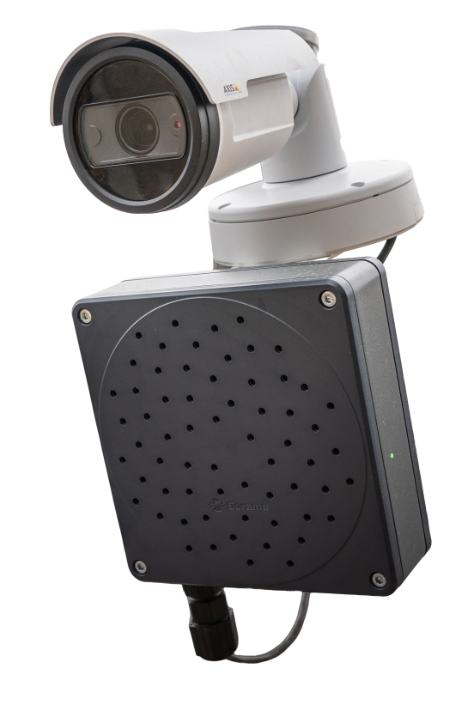
The system combines smart, precisely positioned acoustic sensors with high-definition ANPR cameras to capture both sound and vehicle identity in a single, seamless process. Carefully installed to monitor the live traffic lanes, the acoustic technology pinpoints when a vehicle exceeds acceptable noise levels, while the ANPR camera instantly records the corresponding aging audio, video, and vehicle information together before being transmitted for review. This ensures fast, reliable, and fully connected evidence without the need for manual intervention.
Field Results:
| Vehicle Type | Sound Level | Acoustic Scale | Perceived Noise |
| New Car Standard | 68-72 dBA | Baseline (1x) | Baseline (x1.0) |
| Anti-Social Motorcycle | 91.86 dBA | 63 x louder than baseline | Over 5 human perception |
| Modified Sports Car | 96.21 dBA | 100 x louder than baseline | Over 6 human perception |
Field Results & Data Analysis
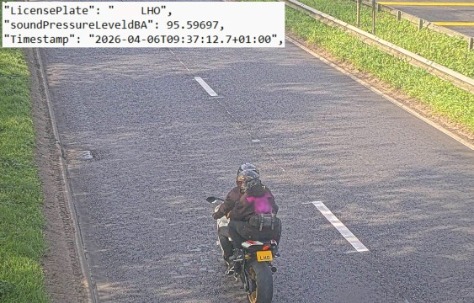
The deployment quickly identified significant acoustic anomalies, with vehicle noise levels far exceeding normal environmental thresholds. Incident cases recorded readings of 96.21 dBA and 91.86 dBA, well above the 68–72 dBA range for standard new vehicles, demonstrating the scale of disruption being experienced.
These results show a clear increase in both measured and perceived noise impact, with affected vehicles registering up to 100x louder than the baseline, contributing to significant community disturbance.
Each event is captured as a secure evidential package through the dashboard, including an un-editable JSON record, a high-resolution image, and a visual heatmap that pinpoints the source of the noise passing through the scene.
The Enforcement Workflow
1. Capture
Acoustic outstations automatically detect excessive vehicle noise and link each event to a vehicle registration plate.
2. Secure Transfer
Evidence is securely encrypted and transmitted via 4G to Truvelo’s cloud-based Violation Management System enforcement platform.
3. Validation
Registered keeper details are retrieved and matched, enabling rapid case creation and evidence packaging.
4. Enforcement Action
Cases are processed through a structured escalation pathway, from education through to formal enforcement where required.
Escalation pathway:
Tier 1: Education & warning letters
Tier 2: Fixed penalties / formal notices
Tier 3: Vehicle seizure / prosecution support
The system replaces manual roadside enforcement with a fully automated, end-to end digital workflow that captures, verifies, and escalates offences in a consistent and evidence led process.
Conclusion
The Hertfordshire pilot shows how automated acoustic enforcement improves the detection and management of vehicle noise offences. By combining acoustic data with ANPR capture, the system delivers clear, objective evidence in real time.
This enables a scalable, proactive approach to
enforcement that supports consistency, reduces
anti-social behaviour, and helps restore peace
to local communities.
Download the Acoustic Monitoring System case study here: